
Challenge. Unlocks Opportunity.
Great teaching requires a prepared educator, engaged learners, and the right tools at the right time. But when classrooms are cramped, desks are crowded, teaching materials are scarce, and lesson preparation happens after a long day of teaching, the system is not failing for lack of effort. It is straining under the weight of physical constraints.
The reality many educational institutions in resource-constrained settings navigate:
- Limited infrastructure: Classrooms are compact, desks are crowded, storage is scarce. How do you deliver rich learning experiences within tight physical boundaries?
- Resource dilution: Textbooks are limited, worn, shared, outdated. Even when rich educational media exists, how do you deliver it equitably when copies are scarce?
- Costly alternatives: Presently available digital resources, if they work offline at all, are often expensive, licenced, locked in. Schools pay repeatedly for content that should be accessible freely.
- Administrative friction: Teachers spend hours on manual record-keeping and paperwork that could be spent on pedagogy.
These are not failures of will. They are constraints of design.
“I never teach my pupils, I only attempt to provide the conditions in which they can learn.”
— Albert Einstein

Simon's Story
Simon is a teacher at a busy primary school. It is 8 o'clock in the morning, and he opens the door to his class to reveal a sea of boys and girls in neat uniforms chattering noisily, crowded around what appears to be an inadequate number of desks. Simon is to teach his six-graders Mendelian genetics this morning: pea plant traits, inheritance patterns — one of the foundations of biology.
He knows his subject. He knows his students. But drawing the diagrams on the blackboard, while maintaining the kids' focus and discipline, and checking their understanding, stretches one teacher thin. Some students grasp it quickly. Others need more time. The bell rings, and he has to move on.
Ever so often, Simon marks huge piles of simple notebooks by hand, adding up scores manually, so the data can be filed for submission to the district level. Commonly, this task takes him into the small hours of the night, as it required attention to detail and diligence.
Simon does not lack commitment. He lacks leverage.
- What if one well-prepared lesson could reach every learner in the room, not by replacing him, but by extending his reach?
- What if rich media, self-paced practice, and collaborative notes could create a connective tissue among students, served by simple, offline devices?
- What if content updates could arrive free and aligned to the national curriculum in a fully automated, offline-enabled manner?
Simon does not need more time. He needs smarter tools.
Our Solution. Less Effort. More Fun. Better Outcomes.
We do not give schools internet. It is unsustainably expensive and often unnecessary.
Instead, we deliver optimal conditions for the delivery of offline teaching media, regardless of the existing infrastructure.

The Building Blocks. Yours by Design.
Our offline learning ecosystem is not a black box. It is a collection of interoperable, free, and open‑source tools that you can deploy based on need, from a single classroom to a district‑wide network.
- Searchable Digital Library: Fully indexed PDFs and ePubs. Students search by keyword, subject, or level – no Internet required. Works on any device with a browser.
- Educational Multimedia: Audio and video pre‑loaded for offline streaming. Diagrams, lectures, demonstrations – rich media that bring abstract concepts to life when textbooks fall short.
- Collaborative Wiki (optional): Classroom notes, shared resources, teacher guides. Built inside the Facility Management Information System (FMIS) – a modular, open‑source system you can deploy piece by piece. Your learning materials integrate with institutional memory, with no lock‑in.
- Assessments and e‑Learning (optional): Quizzes, progress tracking, and feedback loops. Hosted by the FMIS, so your data remain secure, private, and under local control, with the possibility to upgrade to a full educational institutional management system.
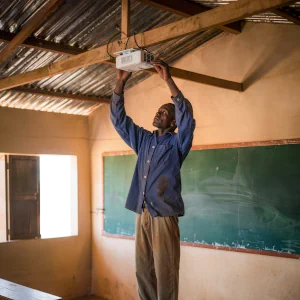
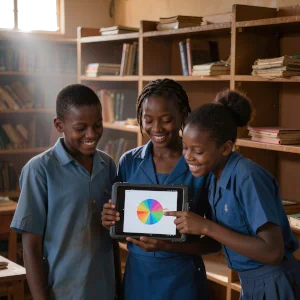
- For Classroom and Library: Same server, same content. Use one robust LED projector for group instruction in a dedicated classroom, where windows can be shaded. Optionally, start building your digital library with as few as five simple 7‑inch tablets for individual exploration, and add more over time as your budget allows. One ecosystem, multiple use cases.
Technology. That Won't Get in the Way.
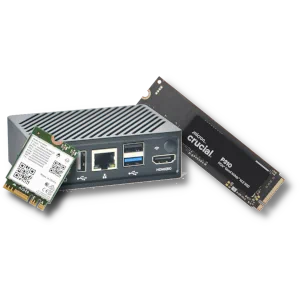
- A Palmful of Server: Extremely efficient, no moving parts, solar‑ready, resilient in harsh conditions.
- Full Local Ownership: Your hardware, your language, your curriculum. Easy customisation means no programmers needed, and swift integration in local languages.
- Fully Offline, yet Integrated: Runs fully offline, auto‑syncs directly or via a standard mobile device as proxy that moves physically to a location with Internet.
- Free and Open-Source Software Throughout: All software is auditable, adaptable, and forever free of licence fees.
Deployment in Practice. Ingredients of Success.
We don't install systems. We introduce, adapt, and integrate.
①
Every deployment starts with a simple assessment.We check infrastructure, access to power, buildings and teaching needs.
②
A single source of educational materials is defined.The source is usually a computer that holds a shared folder with the institution’s teaching materials. This computer may be located at the Ministry of Health, the District Government or at the School's library; military-grade safety provides total flexibility. This source becomes an easy-to-maintain, scalable reference point for all access and updates.
③
The system is then introduced on site.Setup is straightforward and completed within hours, because the tiny server is fully self-contained, includes wireless and feeds off a universal USB power source. No restructuring of infrastructure or workflows is required.
④
Early Adoption - Usage patterns emerge quickly.Some students and staff engage from the start; others follow once added value is visible.
⑤
Iterative Improvements - Over time, the system improves.Materials become increasingly structured, better content replaces weaker content.
⑥
Responsibility is key.A small group of people, ideally drawn from staff and students, maintains content, updates and provides basic support.
⑦
Updates are periodic and simple.New materials are transferred automatically, whenever the server box or a designated mobile device gain access to the Internet, sync updated content and integrate it locally. No continuous connectivity is ever required.
Your School. Your Content. Your Control.
No internet required. No subscription owed. No vendor lock-in.
We don't sell systems. We build partnerships.
Every deployment is co-designed with local educators, adapted to your infrastructure, and owned by your institution from day one.
This isn't about technology. It's about creating the conditions in which learning can flourish.